Creating a comforting vibrant kitchen starts with tools you use every day cooking.
If you want to elevate your daily cooking habits, choosing the right cookware material matters.
It keeps your home environment clean and natural, and your food safe.
We always pour our hearts into picking the freshest ingredients, but we rarely look at what we cook in. Yet, the pan you reach for every day quietly shapes the health of your meals.
- 1. Stovetop Cooking (Boiling, Sautéing, & Searing)
- 2. Oven Baking
- 3. Food Storage (Refrigerating & Freezing)
- 4. Reheating & Warming
- Small Swaps for a Healthier Home
- Trusted, Non-Toxic Brands for Your Kitchen
- 1. Made In Cookware (Best Professional Stainless & Carbon Steel)
- 2. All-Clad (The Gold Standard for Heirloom Stainless Steel)
- 3. Le Creuset (The King of Safe Enameled Cast Iron)
- 4. Lodge Cast Iron (Best Budget-Friendly Raw Cast Iron)
- 5. Xtrema Cookware (The Purist's Choice for 100% Pure Ceramic)
- 6. Pyrex (The Household Classic for Glass Baking & Storage)
- 7. Rubbermaid Brilliance Glass (Premium Airtight Food Storage)
- ❓ Frequently Asked Questions
In Ayurveda, your cookware is never just a cold tool—it is an active part of the nourishment itself.
Years ago, the rule was simple: cook in brass, eat in bronze, and drink from copper. But times change, and so does our modern rhythm of meal-prepping, quick reheating, and fast cleanups.
Choosing the right material isn’t just about preserving vitamins; it is your frontline defense against everyday toxins leaching into your body.
📊 The Quick-Read Summary:
The safest materials for pots and pans are 100% pure ceramic, cast iron, carbon steel, and high-quality stainless steel.
These materials provide a naturally non-toxic cooking surface, without any harmful chemical coatings found in traditional non-stick pans.
Let’s break down the safest kitchen companions for your daily rituals, sorted by how you actually use them.
1. Stovetop Cooking (Boiling, Sautéing, & Searing)
Every metal behaves differently under heat. For your standard daily cooking, these materials keep your food pure and untainted.
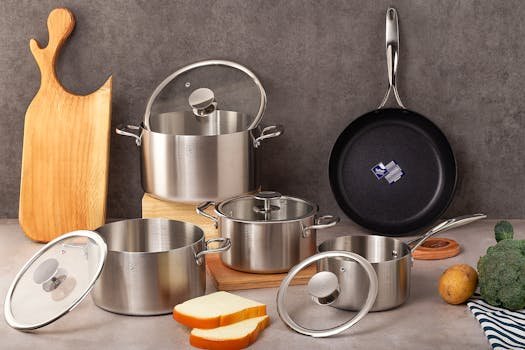
- Stainless Steel (Everyday Cooking & Sautéing)
- Access: High. You can find it in almost any local storefront.
- Durability: High. It resists scratching, defies corrosion, and handles the dishwasher beautifully.
- Cost: Moderate. Pick a set with a copper or aluminum core for even heat distribution.
- Cast Iron & Carbon Steel (High-Heat Searing & Frying)
- Access: High. Readily available online and in standard kitchen shops.
- Durability: Exceptionally High. These pans are virtually indestructible heirlooms if kept seasoned.
- Cost: Low to Moderate. Highly affordable for basic raw iron; enameled versions cost more.
- Brass & Bronze (Slow-Cooking Grains & Lentils)
- Access: Low. Harder to track down outside of specialized artisanal or traditional shops.
- Durability: Moderate. They require regular, meticulous tin-lining maintenance to remain safe.
- Cost: High. These metals are investment pieces due to their weight and craft.
- Pure Clay Pots (Traditional Slow-Cooking)
- Access: Very Low. It is difficult to source authentic, unglazed clay potters locally nowadays.
- Durability: Low. Clay is highly fragile, unforgiving to drops, and demands gentle hand-washing.
- Cost: Moderate. While the raw material is cheap, constant replacement from breakage adds up.

2. Oven Baking
Baking requires steady, ambient heat distribution without synthetic coatings flaking into your dough.
- Borosilicate Glass (Casseroles & Roasted Veggies)
- Access: High. Found easily in any supermarket baking aisle.
- Durability: Moderate. Completely non-reactive, though prone to shattering if dropped or shocked thermally.
- Cost: Low. Highly economical and lasts a lifetime with proper care.
- Enameled Cast Iron (Artisan Breads & Dutch Oven Bakes)
- Access: High. Readily available from mainstream kitchen brands.
- Durability: High. Thick and sturdy, though the glass-like enamel can chip if banged roughly.
- Cost: High. A quality enameled piece is a premium investment tool.
- Food-Grade Silicone (Muffins & Light Pastries)
- Access: High. Widely available online and in department stores.
- Durability: Moderate. Won’t break or rust, but can degrade, warp, or retain odors over time.
- Cost: Low. Very budget-friendly for casual bakers.
3. Food Storage (Refrigerating & Freezing)
When food sits for days, it has prolonged contact with its container. Keeping that environment inert prevents dangerous chemical leaching.
- Glass Containers (Best Overall Storage)
- Access: High. Ubiquitous in storage aisles and online shops.
- Durability: Moderate. Completely safe and stain-proof, but requires careful handling to avoid chips.
- Cost: Moderate. Slightly higher upfront cost than plastic, but saves money long-term.
- Stainless Steel Containers (Perfect Fridge Storage)
- Access: Moderate to High. Readily found online and in global specialty markets.
- Durability: Exceptionally High. Unbreakable, scratch-resistant, and perfect for stacking.
- Cost: Moderate. Highly cost-effective given that they are virtually indestructible.
4. Reheating & Warming
The sudden application of heat to cold food can force low-quality containers to gas off synthetic compounds.
- Glass & Ceramic (Best for Microwaves)
- Access: High. Standard across all households.
- Durability: High under heat, though vulnerable to physical impacts.
- Cost: Low to Moderate. An essential, affordable microwave staple.
- Stainless Steel (Best for Cooktop Reheating)
- Access: High. Easily pulled right out of your existing cookware set.
- Durability: High. It tolerates rapid stovetop temperature shifts without warping.
- Cost: Low. Since you already use it for cooking, it doubles as a free reheating tool.
Small Swaps for a Healthier Home
If you are standing in your kitchen right now wondering what needs to go, take a deep breath.
Building a toxic-free kitchen doesn’t have to happen overnight.
By making a few intentional swaps—trading old, scratched nonstick pans for a reliable stainless steel pot or glass dish—you are gently bringing harmony back to your kitchen and your body.
Simplifying your kitchen setup does not require a complete overhaul overnight; instead, it is about making intentional, lasting swaps.
When streamlining your daily rituals, look to the reliable staples that balance health, longevity, and ease of use.
- For stovetop cooking, let stainless steel and cast iron be your durable workhorses.
- When moving to the oven, lean heavily on the clean performance of borosilicate glass and enameled cast iron.
- For storing your precious leftovers safely, stick with glass containers and stainless-steel containers.
- Finally, when it is time to warm things up, rely on glass or ceramic for the microwave and stainless steel for the stovetop.
By focusing your collection around these foundational materials, you create a kitchen that is naturally aligned with wellness, simple habits, and truly nourishing food.
Trusted, Non-Toxic Brands for Your Kitchen
When I first decided to clear the hidden toxins out of my kitchen, I felt completely overwhelmed by the rows of shiny pans in the stores, all wrapped in clever marketing.
It is easy to feel lost when every box promises it is “green” or “healthy.” Over time, I learned to look past the slogans and look straight at the underlying materials.
To save you the late-night research and guesswork, I have curated a handful of highly transparent, gold-standard brands that I fully trust to keep your food pure, clean, and truly nourishing.
1. Made In Cookware (Best Professional Stainless & Carbon Steel)
- Why It Is Trusted: A massive favorite among professional chefs, Made In Cookware is highly praised for its heavy-duty 5-ply stainless steel and slick carbon steel frying pans. Their raw materials are independently lab-tested by third-party facilities to ensure they are completely free of toxic chemical coatings, PFAS, and heavy metals.
- Best For: Everyday high-heat searing, boiling, and sautéing.
2. All-Clad (The Gold Standard for Heirloom Stainless Steel)
- Why It Is Trusted: The absolute premium champion for stainless steel pieces. All-Clad uses a multi-ply bonded metal construction that ensures completely even heat distribution. Because they completely lack synthetic coatings, these pans do not degrade over time and will literally last a lifetime with basic care.
- Best For: Everyday home cooking, robust pan sauces, and frying.
3. Le Creuset (The King of Safe Enameled Cast Iron)
- Why It Is Trusted: The legendary name for heirloom-quality enameled cast iron. Le Creuset applies a smooth, glass-like enamel coating over heavy iron, making it completely non-reactive. It completely eliminates the risk of heavy metal leaching or chemical degradation, requiring zero initial seasoning.
- Best For: Slow-simmered soups, rich stews, and cozy braising.
4. Lodge Cast Iron (Best Budget-Friendly Raw Cast Iron)
- Why It Is Trusted: The most accessible, iconic champion for raw, rugged cast iron. Proudly made in the USA, Lodge pans come pre-seasoned with natural vegetable oil. They are completely indestructible, completely chemical-free, and offer the absolute best heat retention for the price point.
- Best For: Frying, rustic baking, outdoor grilling, and high-heat searing.
5. Xtrema Cookware (The Purist’s Choice for 100% Pure Ceramic)
- Why It Is Trusted: Unlike hybrid nonstick pans that simply use a thin ceramic chemical spray, Xtrema manufactures 100% pure ceramic cookware using only natural clay, minerals, and water. It contains zero metals, zero PFOA, and features no synthetic chemical glazes, making it completely inert and safe for long-term health.
- Best For: Slow-cooking grains, delicate sauces, and low-and-slow simmering.
6. Pyrex (The Household Classic for Glass Baking & Storage)
- Why It Is Trusted: A multi-generational US household staple for clean kitchen storage. Made of thick, thermal-resistant borosilicate or tempered glass, Pyrex dishes are completely non-reactive, non-porous, and stain-proof. They will never absorb old food odors or leach compounds into your food.
- Best For: Oven-baked casseroles, weekly meal prep, and fridge-to-microwave storage.
7. Rubbermaid Brilliance Glass (Premium Airtight Food Storage)
- Why It Is Trusted: The top modern solution for 100% leakproof, airtight food storage. The glass line from Rubbermaid features crystal-clear, durable glass bases that handle rapid reheating effortlessly. It offers a beautifully clean alternative to toxic plastic storage options that leach under heat.
- Best For: Longevity storage, freezing leftovers, and clean microwave reheating.
❓ Frequently Asked Questions
Do I need to throw away all my nonstick pans immediately?
Not necessarily, but you should inspect them. If your traditional nonstick pans are scratched, flaking, or heavily worn, they can release micro-particles into your meals and should be retired right away.
Is ceramic-coated cookware actually safe?
It depends on transparency.
True 100% pure ceramic is fully non-reactive and highly safe.
Always choose reputable brands that explicitly verify they are completely free of PFAS, lead, and cadmium.
Why does food stick to my stainless steel pans?
Stainless steel has microscopic pores that expand when heated.
If you drop cold food onto a cold pan, the metal shrinks around the food and causes sticking.
To prevent this, always preheat your stainless steel pan first, add your oil or fat, let it warm up, and then add your ingredients.
Can I store acidic food in cast iron?
Avoid long-term storage or cooking of highly acidic foods (like tomato sauce or lemon juice) in raw cast iron, as the acid can strip away your seasoned coating and leach a metallic taste into your food.
For heavy acid cooking or food storage, reach for enameled cast iron or stainless steel instead.
🗺️ For Your Wellness Journey
Want to know if heavy, fiery, or scattered elements are the primary drivers of your body energy patterns today?
Take our 2-minute Current Body Rhythm Quiz to uncover your personalized profile.
🌿🌿🌿