Have you ever felt that rising temperature adds on to anxiety issues or makes you get irritated easily?

This week felt like the weather flipped a switch. One day was cool spring air; the next was a sudden forty‑degree jump that turned everything into a furnace.
At work, we were launching a new project, already full of deadlines and decisions.
By mid‑morning, my boss was racing around the office until she finally stopped, pressed her hand to her forehead, and said, “I can’t handle this heat and this stress together.”
That’s when it clicked. It wasn’t just the workload—it was the temperature swing. That blast of external heat stacked right on top of her internal heat.
For someone with strong Pitta tendencies, that double fire doesn’t just add up; it amplifies everything.
We often underestimate how much heat shapes emotional health. When temperatures spike suddenly, the mind can feel sharper, tighter, and more reactive.
What We Know So Far: Heat and Anxiety
Modern research has consistently shown that heat affects emotional regulation, and people experience more anxiety, agitation, and stress during hotter conditions. This aligns closely with what Ayurveda has described for thousands of years about Pitta dosha heat symptoms and emotional imbalance.
Here’s what current science tells us:
- Heat increases anxiety symptoms.
A 2022 JAMA Psychiatry study found that emergency visits for anxiety disorders rose significantly on hotter days. This supports what many people describe as heat‑induced anxiety or summer anxiety—a spike in worry, tension, and overwhelm when temperatures climb. - Heat activates the sympathetic nervous system.
When the body overheats, the brain interprets it as a stressor. Heart rate increases, breathing becomes shallow, and cortisol rises. This creates the same physiological pattern seen in anxiety. - Sleep disruption increases anxiety.
Hot nights reduce deep sleep, and poor sleep is one of the strongest predictors of next‑day anxiety. - People with high‑pressure roles react more strongly to heat.
Behavioral psychology research shows that individuals with perfectionistic or high‑responsibility tendencies—classic Pitta traits—experience more emotional reactivity during heat exposure. - Heat amplifies irritability and urgency.
While irritability is its own topic, research shows that heat increases emotional volatility, which can intensify the urgency and pressure behind Pitta‑type anxiety.
In short: heat doesn’t just make you uncomfortable—it changes how your mind processes stress, which is exactly what Ayurveda describes as Pitta rising in the mind.
The Brioveda Lens
How Ayurveda Explains Pitta‑Driven Anxiety
Ayurveda describes Pitta as the energy of fire and transformation. It governs digestion, metabolism, clarity, and discernment. In the mind, Pitta shows up as:
- focus
- ambition
- precision
- drive
- intensity
But when Pitta becomes excessive—through heat, stress, spicy foods, overworking, or overstimulation—it creates Pitta dosha mental imbalance, which often shows up as anxiety.
How Pitta Causes Anxiety, Irritability, and Fatigue
Pitta is the dosha of fire, brilliance, and transformation. When it’s balanced, you feel clear, capable, and energized in a steady, sustainable way. But when Pitta overheats—especially in the mind—it can create a very specific kind of emotional turbulence. One of the most common expressions of this is Pitta‑driven anxiety, a pattern that feels hot, urgent, pressured, and mentally inflamed.
Common pitta anxiety symptoms include:
- racing thoughts with a sense of urgency
- pressure to fix or solve everything immediately
- over analysis or mental “overheating”
- perfectionism that spirals into worry
- frustration mixed with anxiety
- heat in the face, chest, or head
- tension headaches
- digestive heat (acidity, burning, hunger spikes)
Ayurveda explains this through the qualities of Pitta:
- Hot → overheated thoughts
- Sharp → overthinking, self‑criticism
- Light → emotional depletion
- Mobile → racing thoughts
- Oily → sticky, looping thoughts
When these qualities accumulate, the mind becomes inflamed. This is the Ayurvedic explanation for anxiety that feels intense, urgent, or fiery.
Why Pitta Anxiety Feels Different
People often describe Pitta anxiety as:
- “I feel like I’m running out of time.”
- “My mind won’t stop analyzing.”
- “I’m overwhelmed but still pushing.”
- “Everything feels too much.”
This is the Pitta dosha stress response—a blend of heat, pressure, and intensity that creates emotional burnout if left uncooled.
How to Balance Pitta Affecting Anxiety (Pitta in the Mind)
This routine is designed specifically for pitta imbalance anxiety relief—not general Pitta imbalance. It cools the mind, softens intensity, and reduces internal heat.
1. Start the Morning Cool and Slow
- Avoid hot showers first thing.
- Splash cool or room‑temperature water on the face and neck.
- Step outside for a few minutes of cool morning air.
This reduces the early‑morning Pitta spike and supports a calmer start.
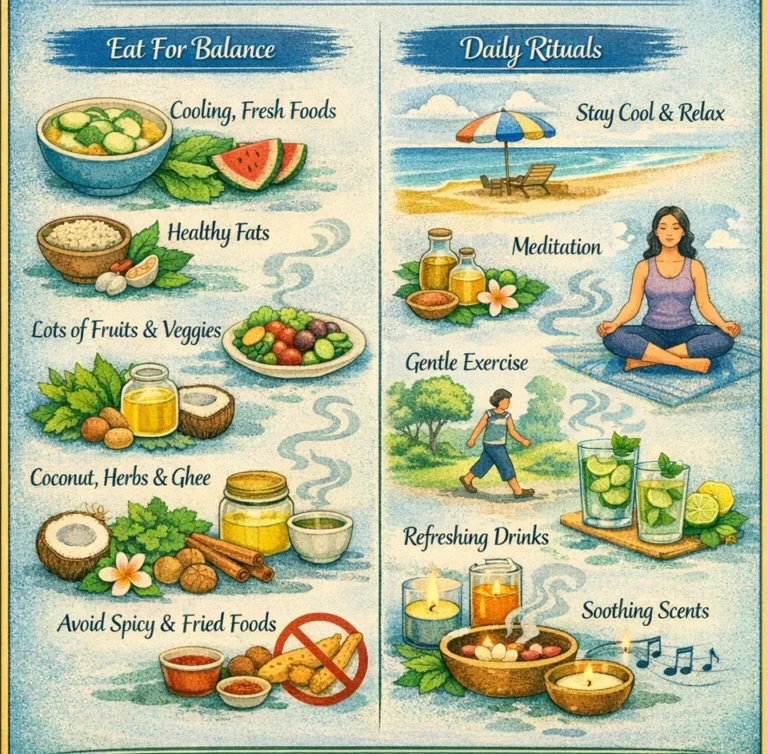
2. Eat Cooling, Grounding Meals at Regular Times
Pitta anxiety worsens when meals are skipped or delayed.
Choose foods that support ayurvedic lifestyle for pitta mind:
- cucumbers
- coconut
- mint
- sweet fruits
- basmati rice
- ghee
Avoid spicy, sour, or acidic foods when anxiety is high.
3. Build Cooling Pauses Into Your Day
Every 2–3 hours:
- place a cool hand on the back of your neck
- breathe slowly through the nose
- soften the jaw and belly
These micro‑pauses prevent heat accumulation and calm the pitta mind imbalance signs before they escalate.
4. Choose Cooling Movement
Avoid intense workouts when anxiety feels fiery.
Instead choose:
- swimming
- evening walks
- gentle yoga
- stretching
- slow cycling
Movement should feel soothing, not stimulating.
5. Create a Cooling Evening Ritual
- dim lights early
- avoid screens 1 hour before bed
- drink warm (not hot) mint or rose tea
- use a cool compress on the forehead or eyes
This helps release the day’s heat and supports deeper sleep.
Tips for Managing Pitta‑Driven Anxiety
- Keep a cool water bottle nearby during work.
- Avoid multitasking—Pitta anxiety thrives on overload.
- Step away from heated conversations.
- Keep your environment visually calm.
- Avoid working during the hottest part of the day.
- Choose cooling scents like rose, vetiver, or sandalwood.
- Keep your to‑do list realistic—overcommitment fuels anxiety.
These are simple ayurvedic tips for pitta anxiety that support emotional cooling.
If your anxiety feels hot, pressured, or mentally “on fire,” your Pitta may be asking for a gentler rhythm.
You don’t have to push through or power over your symptoms—your body is simply signaling that it needs cooling, grounding, and softer boundaries.
If you’re ready to understand your unique mind‑body pattern and explore cooling practices for Pitta dosha in a nurturing, sustainable way, continue your Brioveda journey.
Your inner fire is meant to illuminate your life, not burn through it.
Want to explore ayurvedic living? See start here.
Q & A
Q1: Can Pitta cause anxiety even if I’m not a Pitta type?
Yes. Anyone can experience pitta emotional imbalance due to heat, stress, spicy foods, or intense routines.
Q2: Why does my anxiety get worse in summer?
External heat increases internal heat, which amplifies summer anxiety pitta patterns.
Q3: Is Pitta anxiety the same as burnout?
They’re related. Pitta anxiety is the overheating stage; burnout is the depletion stage.
Q4: Can Pitta anxiety show up physically?
Yes—heat in the face, acidity, headaches, sweating, or a tight chest are common.
Q5: Does caffeine make Pitta anxiety worse?
Often yes. Caffeine adds heat and sharpness, intensifying pitta dosha mental imbalance.
Takeaway
Pitta‑driven anxiety is heat‑driven anxiety. When the mind becomes too sharp, too hot, or too pressured, emotional resilience melts.
Cooling, grounding, and softening your daily rhythm helps restore clarity without intensity. Your fire is powerful—when it’s balanced, it becomes your greatest strength.
If this brought you clarity today, feel free to share it with someone who might need it.