Modern life asks a lot of us — constant notifications. It’s no surprise that many people are experiencing something deeper than stress: nervous system exhaustion.
And sometimes, the earliest signs show up in the smallest, quietest moments — like what I witnessed one Thursday afternoon at work.

It happened on an ordinary Thursday — the kind of day when everyone was trying to wrap up loose ends before the month closed.
Our team had just been assigned three new mandatory online trainings, all moved to a new portal none of us had used before.
I glanced over at my coworker, someone who was already juggling a heavy workload, and watched her slowly lean forward, resting her forehead on her desk with a long, tired sigh.
Not dramatic. Not loud. Just… defeated.
At lunch, I sat with her and gently asked what felt heavy.
She didn’t complain.
She didn’t rant.
She simply said, “These tech things are not my cup of tea.
They changed everything again. It’s just… too much right now.”
And at that moment, I realized it wasn’t the training itself. It was the accumulation — the constant adjusting, the nonstop learning curve, the pressure to keep up.
She wasn’t lazy or unmotivated. She was exhausted in a way that went deeper than being “busy.” Her nervous system was tired.
We often imagine exhaustion as something dramatic — collapsing, crying, shutting down.
But more often, it looks like this: a quiet sigh, a heavy pause, a moment where the mind and body whisper, “I can’t take one more thing.”
This isn’t a medical diagnosis. It’s a phrase people use to describe the feeling of being mentally overloaded, emotionally stretched thin, and physically depleted all at once. Think of it as your inner wiring saying, “I’m tired. I need a moment.”
Let’s explore what we know so far, the early signs to look for, and how ancient wisdom helps us understand this modern experience.
What We Know So Far About Nervous System Exhaustion
Nervous system exhaustion is often described as a state where your internal “alert system” has been running for too long without enough recovery. People commonly use this term when they feel:
- mentally foggy
- emotionally reactive
- physically drained
- overwhelmed by small tasks
- disconnected from their usual sense of self
It’s not about weakness or lack of resilience. It’s about capacity — and how easily that capacity gets stretched in a world that rarely slows down.
While everyone experiences stress, nervous system exhaustion feels different. It’s not just a bad day. It’s a pattern of subtle signals that build over time.
Early Signs of Nervous System Exhaustion
These signs often show up quietly at first — small shifts that are easy to dismiss. But when you notice them together, they paint a clearer picture.
1. Why You May Feel “Wired but Tired”
You’re exhausted, but your mind won’t settle. You may feel alert at the wrong times and sluggish when you need energy.
2. When Emotional Sensitivity Becomes a Signal
Little things feel bigger. You may cry more easily, feel irritated quickly, or feel overwhelmed by situations that normally wouldn’t affect you as much.
3. Difficulty concentrating
Your thoughts feel scattered. You reread the same sentence. You start tasks and forget what you were doing. Your brain feels “full.”
4. Restlessness in the body
Fidgeting, pacing, or feeling like you can’t fully relax — even when you’re physically still.
5. Sleep disruptions
Trouble falling asleep, waking up frequently, or waking up feeling unrefreshed.
6. Sensory overload
Noise feels louder. Lights feel brighter. Crowded spaces feel overwhelming. Even small stimuli feel like “too much.”
7. Feeling detached or numb
You may feel disconnected from your emotions, your creativity, or your usual sense of joy.
8. Reduced resilience
Things that you normally handle with ease suddenly feel heavy or complicated.
These signs don’t mean something is wrong with you. They mean your system is asking for gentleness, space, and a slower rhythm.
Related Research & Data
While “nervous system exhaustion” isn’t a clinical term, research on stress, emotional overload, and cognitive fatigue helps us understand the experience.
Here’s what studies show:
1. Chronic stress affects cognitive clarity
Research suggests that prolonged stress can impact attention, working memory, and decision-making — which aligns with the “brain fog” many people describe.
2. Emotional overwhelm is linked to sensory sensitivity
Studies show that when the nervous system is taxed, people become more sensitive to noise, light, and social interactions.
3. Sleep disruption is a common early indicator
Sleep researchers note that difficulty falling asleep or staying asleep is often one of the first signs of nervous system strain.
4. The body holds emotional load
Emerging research in mind‑body science shows that emotional stress can influence physical tension, restlessness, and fatigue.
5. Over‑optimization contributes to mental fatigue
Recent wellness trend reports highlight that constant self‑tracking, productivity pressure, and “always improving” mindsets can lead to emotional burnout and nervous system strain.
Common Questions
Here are a few questions people often ask when they start noticing these early signs.
1. Is nervous system exhaustion the same as burnout?
Not exactly. Burnout is usually tied to work or chronic stress. Nervous system exhaustion is more holistic — it includes emotional, sensory, and cognitive fatigue.
2. Can this happen even if my life looks “normal”?
Absolutely. You don’t need a dramatic event to feel overwhelmed. Small, constant pressures add up.
3. Does this mean something is wrong with me?
No. It means your system has been working hard for a long time. It’s a sign of capacity, not character.
4. Can emotional overload cause physical symptoms?
Emotions and the body are deeply connected. Many people notice tension, restlessness, or fatigue when they’re emotionally stretched.
5. Is this permanent?
No. With awareness and supportive routines, many people feel more grounded and steadier again.
The Brioveda Lens
From Ayurvedic perspective, the mind and body are deeply intertwined. When life becomes fast, loud, or emotionally heavy, the subtle energies that govern clarity, steadiness, and emotional balance can become disrupted.
This lens helps us see nervous system exhaustion as:
- a sign of internal movement becoming irregular
- a shift in the natural balance between rest and stimulation
- a call to return to grounding, simplicity, and sensory nourishment
- a reminder that the mind needs softness just as much as the body
It’s not about fixing anything. It’s about understanding the deeper patterns that shape how we feel.
Ritual
Ayurveda describes this nervous system functionality is rooted in Mana (the mind) and Vata (dosha) coordination. Mana and Vata work together for any perception.
A bit disturbance of either of them, causes nervous system exhaustion. So nervous system exhaustion can be eased with balancing Vata and Mana coordination.
Most of mental activities are controlled, motivated and regulated by Vata dosha.
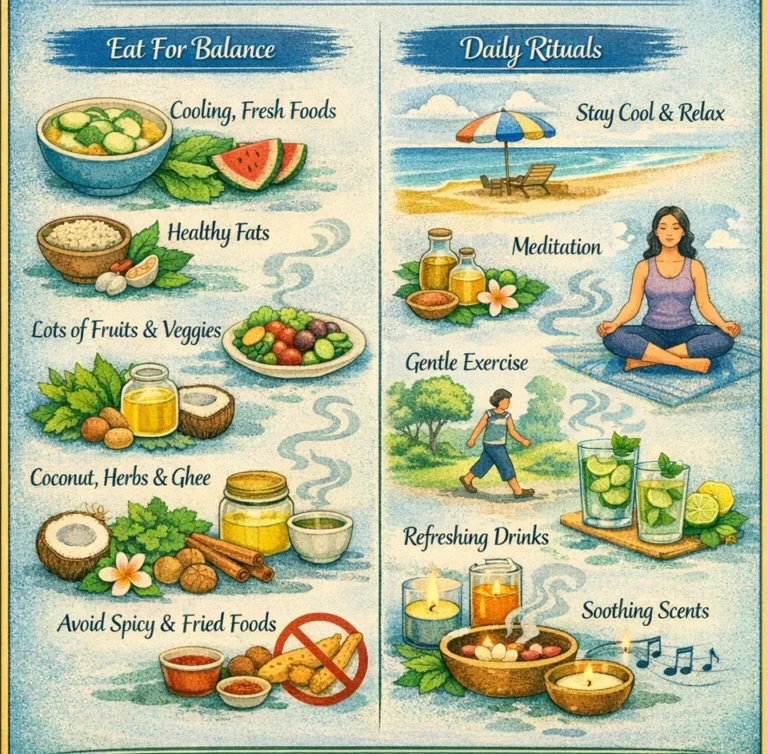
Vata can be balanced with this simple routine explained in another post.
While Mana enlightening takes few more efforts. As per Ayurveda’s main focus ‘heal at home’, Mana functionality can be improved by diet and Vichara (Mindful living).
- Slow down – spare at least one hour per day for yourself, to wind down.
- Improve your sleep quality.
- Focus on Satvik diet (A deeper guide on Satvik food is coming soon).
- Practice Vata pacifying ritual as needed.
Tips for Recognizing Early Signs
🌿These gentle reminders can help you tune into your inner signals before exhaustion deepens.
- Notice when your mind feels “loud” even in quiet moments
- Pay attention to small irritations — they often carry messages
- Check in with your energy throughout the day
- Observe your sleep patterns without judgment
- Notice when your senses feel overstimulated
- Give yourself permission to pause when something feels “too much”
🌿Awareness is the first step toward feeling more grounded.
🌿If you’re reading this and thinking, “This feels like me,” you’re not alone. Many people are quietly carrying emotional and sensory overload without having the words for it.
That’s why I created the 7-Day Mindful Living Challenge — a gentle, beginner-friendly reset designed to help you reconnect with yourself through tiny, doable moments of presence. It’s soft, simple, and crafted for real life.
You deserve a week that feels lighter.
Curious about your mind–body type? Take the gentle, beginner‑friendly Dosha Quiz.
New to Brioveda? Start here for simple, grounding steps to feel more like yourself.
Takeaway
Nervous system exhaustion isn’t a failure — it’s a signal.
A whisper from within saying:
“I’ve been carrying a lot. I need a softer rhythm.”
By noticing the early signs — emotional sensitivity, restlessness, sensory overload, sleep changes, and mental fatigue — you give yourself the gift of awareness. And awareness is the beginning of healing, grounding, and returning to yourself.
You don’t have to rush.
You don’t have to optimize.
You just have to notice.
If this brought you clarity today, feel free to share it with someone who might need it.