I love how simple this is — just butter, a pot, and a little patience. Homemade ghee always feels like a small gift to yourself.
Why This Recipe Helps
In Ayurvedic living, you will see a lot of routines that call for an ingredient — Ghee. Ghee is used as a base in many ayurvedic medicines, and it is an amazing medicine by itself.
Ghee is useful in the winter skin routine. It keeps skin smooth and moist. It also heals dry skin.
You can buy ghee from grocery stores, but not all of them are made the same. If you are interested in homemade ghee, it is not that difficult to make it at home.
You can follow this step-by-step recipe and make your own ghee.
🍶Ghee Recipe
Prep Time: 45 minutes
Yield: about 2 cups of Ghee (28-32 tablespoons)
Ingredient List
- 16 oz – Unsalted butter
Instructions
- In a thick bottomed pan, melt 4 sticks of unsalted butter.
- Melt it on medium-high heat.
- Once the butter melts, lower the flame.
- As evaporating starts, cloudy part – foam bubbles moves onto the edges slowly, and the clear circle in the center gets larger (see image below).
- Once it becomes clear and transparent, move the pan onto a cool place.
- Let it cool 5 minutes, if the cloudy part sets to the edges — your ghee is done.
Notes
- Keep it stirring in between until the water part evaporates.
- Watch it closely until butter becomes clear.
- Let it cool for about 45-60 minutes more, and strain it in the jar or container of your choice.
Troubleshooting
- Cloudy: Boil it a little more, has some water in it.
- Brown edges: Take it off the stovetop, ghee is burning.
- Brown bottom: Take it off the stovetop, it is over done. You may use it – it may not solidify.
Step-by-step Photos

Unsalted butter:

Melted butter:
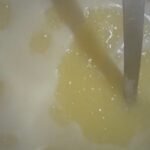
Formed foam bubbles:

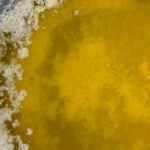
Watch it closely until butter becomes clear like this.
Brioveda Tips
Do not worry about residues setting down at the bottom, just do not let it get brown (burnt).
How to know if your ghee is done? Move ghee pot to cool surface, if you can see pot’s bottom through ghee, it is done!
Ghee has other variations with added herbs for medicinal purposes.
This is a plain ghee recipe. You will see those variations in individual ayurvedic routine posts.
Nutrition
I’ll give you 1 tablespoon (your main serving size) and the 1/3 tablespoon equivalent you’ll see whenever a routine calls for 1 teaspoon.
Nutrition of Ghee
(Approximate, based on standard USDA values)
Per 1 tablespoon ghee
- Calories: ~120
- Total fat: ~14 g
- Saturated fat: ~9 g
- Monounsaturated fat: ~4 g
- Polyunsaturated fat: ~0.5 g
- Carbohydrates: 0 g
- Protein: 0 g
- Sugar: 0 g
- Sodium: 0 mg
Ghee is almost entirely fat, so the numbers are very consistent across brands.
Per 1/3 tablespoon ghee
- Calories: ~40
- Total fat: ~4.7 g
- Saturated fat: ~3 g
- Monounsaturated fat: ~1.3 g
- Polyunsaturated fat: ~0.15 g
- Carbohydrates: 0 g
- Protein: 0 g
- Sugar: 0 g
- Sodium: 0 mg
Health & Wellness Benefits of Ghee
(General wellness information — not medical advice)
1. Supports digestion
Ghee contains short‑chain fatty acids like butyrate, which are associated with gut lining support and smoother digestion. In Ayurveda, it’s used to kindle agni (digestive fire) in a gentle, nourishing way.
2. A stable cooking fat
Ghee has a high smoke point, which means it stays stable at higher temperatures. This makes it a good option for sautéing, roasting, and everyday cooking.
3. Nourishing for the nervous system
Ayurveda considers ghee grounding and calming — often used to support focus, memory, and overall steadiness. Modern nutrition aligns with this by recognizing the role of healthy fats in brain function.
4. Naturally lactose‑free
During the clarification process, milk solids are removed. Many people who avoid lactose find ghee easier to tolerate than butter.
5. Rich in fat‑soluble vitamins
Ghee naturally contains vitamins A, D, E, and K — nutrients that support skin, immunity, and overall vitality.
⚠️ Gentle Alerts & Considerations
(General wellness guidance — not medical advice)
1. High in calories and saturated fat
Ghee is energy‑dense. Using it mindfully is important if someone is watching overall fat or calorie intake.
2. Not suitable for everyone
People with certain health conditions — especially those involving fat metabolism or cardiovascular concerns — may need to limit saturated fats. A healthcare professional can offer personalized guidance.
3. Portion awareness matters
A little goes a long way. Even in Ayurveda, ghee is used intentionally, not excessively.
4. Allergies
While ghee is typically lactose‑free, trace milk proteins may remain. Anyone with a severe dairy allergy should be cautious.
Storage & Variations
Store it in a closed container, away from direct sunlight.
Ghee has a long shelf life, it stays good for 6–8 months at room temperature.
Takeaway
🌿Ghee is very easy to make at home from unsalted butter or sweet cream unsalted butter.
🌿Ghee can be used in ayurvedic routines as a base as it enhances the herb’s medicinal effectiveness — improves absorption.
🌿A few minutes on the stove gives you a golden, versatile staple you can use in both Ayurvedic routines and everyday meals.
If this brought you clarity today, feel free to share it with someone who might need it.